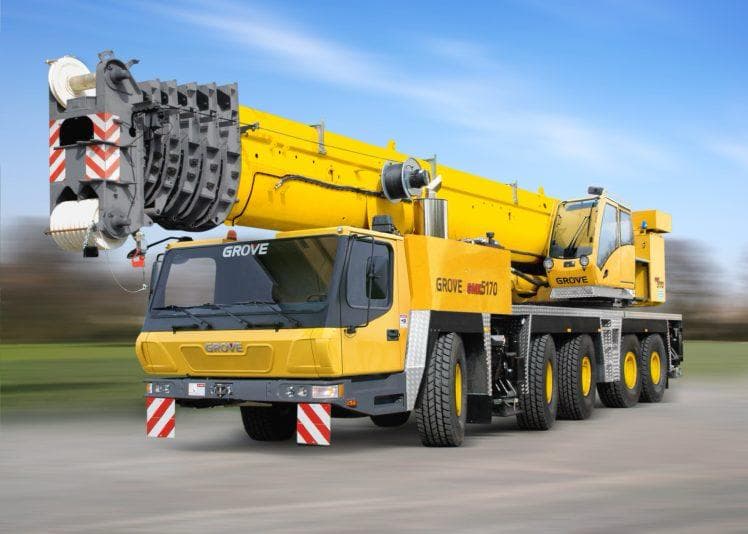
The number on a mobile crane, 25 ton or 50 ton, is its maximum rated capacity: the most it can lift with a short boom, the outriggers fully out, and the load right next to the crane. On a real job the load is rarely that close. So the right question is not "how heavy is the load?" but "how heavy is the load, and how far from the crane does it have to go?"
Capacity Falls as the Radius Grows
Radius is the horizontal distance from the crane's centre of rotation to the hook. Every crane has a load chart that gives the safe load for each combination of boom length and radius. As the radius grows, the safe load falls faster than you might expect, because the load acts on a longer lever. At the radius of a typical site lift, a 25 ton crane may be rated for only a small fraction of its 25 tonnes.
That is why the same air-conditioning unit can be an easy lift for a 25 ton crane parked beside the building, and too much for it when the crane has to stand across the road and reach over a boundary wall.
| 25 Ton Crane | 50 Ton Crane | |
|---|---|---|
| Typical loads | Generators, AC units, pumps, small precast, light steel | Heavier steel and precast, tanks, transformers, plant items |
| Best when | The crane can stand close to the load and its landing point | The load is heavy, far from the crane, or lifted high |
| Site footprint | Smaller; suits tight yards and villa streets | Larger; needs more space and firm ground for the outriggers |
| Common sites | Factories, warehouses, villas, low-rise buildings | Industrial estates, port laydown areas, plant shutdowns |
Three Measurements That Decide the Crane
- ✓Load weight, including rigging: add the slings, shackles, and any spreader beam to the weight of the item itself.
- ✓Radius: from where the crane can actually set up, outriggers out, to where the load lands. If the load is picked at one radius and landed at another, give both.
- ✓Height: what the load must clear, such as a parapet, roof edge, or stack of materials. This sets the boom length, and a longer boom lowers capacity again.
Measure the radius from the real set-up position, not the ideal one. Parked vehicles, trenches, overhead lines, and soft ground often push the crane further away than planned, and a few extra metres can change the crane you need.
When to Step Up to 50 Ton
- ✓The lift is near the limit of a 25 ton crane's load chart at your radius
- ✓The crane must reach over a building, wall, or trench to land the load
- ✓The load goes onto an upper floor or roof, needing a long boom
- ✓Several heavy items are lifted from one set-up position, some at long radius
- ✓Ground or access forces the crane to stand further away than you would like
A crane working near its limit has no margin for wind, a load heavier than its paperwork says, or a radius a little longer than measured. A bigger crane working comfortably inside its chart is the safer choice.
When a 25 Ton Crane Is Enough
For a generator onto a plinth beside the access road, offloading a trailer in a factory yard, or setting light steel on a single-storey shed, a 25 ton crane is usually the economical choice. It is the smaller machine, so it suits tight yards and narrow access better.
Ground Matters as Much as Capacity
A crane's outriggers concentrate its weight and the load into a few small pads. On compacted, level ground that is fine. On recent backfill, sabkha near the coast, or the edge of an excavation, the ground can give way. A larger crane puts more load through each outrigger, so if you step up to 50 ton, check the set-up area is firm and use outrigger mats where the ground is doubtful.
Not sure which size fits? Send the weight, radius, and height to Abdul Masood Trading. The lift is checked against the crane's load chart before the crane is booked, so you neither under-size it nor pay for capacity you don't use.
Need Equipment for Your Next Project?
Talk to our team for a quote on cranes, tippers, boom loaders, forklifts, excavators, JCBs, or wheel loaders anywhere in Oman.
Request a Quote on WhatsAppCall +968 7928 8727